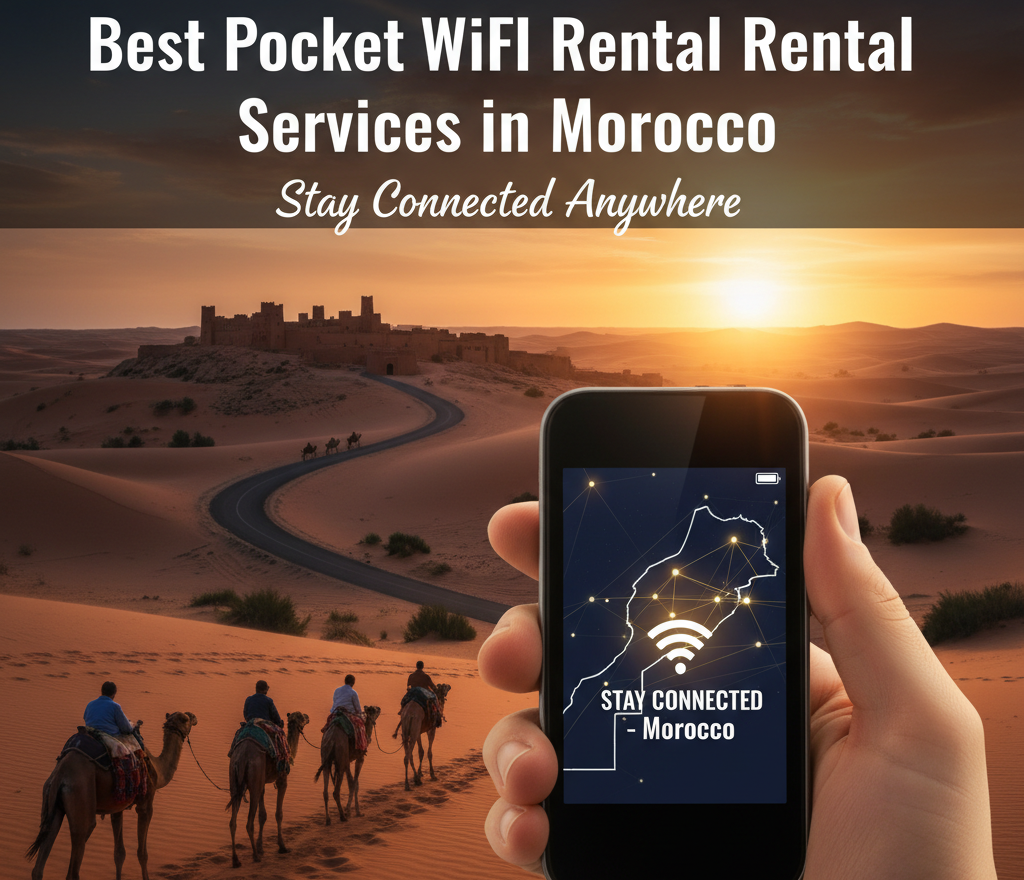
Top Tips for Using Pocket WiFi in Morocco Efficiently
Planning a trip to Morocco? From the bustling souks of Marrakech to the serene dunes of the Sahara, staying connected is more than a convenience—it’s a necessity. Whether you’re navigating ancient medinas, sharing breathtaking photos, or simply checking in with loved ones, a reliable internet connection is your lifeline. While options like local SIM cards and international roaming exist, renting a Pocket WiFi device has emerged as the preferred solution for many savvy travelers, offering flexibility, security, and ease of use for groups. This comprehensive guide dives deep into everything you need to know to use your Pocket WiFi in Morocco efficiently, ensuring you get the most out of your device and your trip. We’ll cover network coverage, battery optimization, security protocols, and practical usage tips, all designed to keep you seamlessly connected from the Atlantic coast to the Atlas Mountains.
Understanding Morocco’s Mobile Network Landscape: Coverage is Key
Before you even turn on your Pocket WiFi, understanding the mobile network infrastructure in Morocco is crucial for setting realistic expectations and planning your connectivity strategy. The country boasts a surprisingly robust and modern telecommunications network, primarily managed by three major operators: Maroc Telecom, Orange Morocco, and INWI . These providers collectively ensure that nearly 100% of the country has access to 4G LTE services, making high-speed internet widely available even in many rural areas . For travelers in major cities like Casablanca, Rabat, Marrakesh, Fes, and Agadir, you can expect excellent 4G coverage and speeds . Coverage maps from these operators show extensive networks, so it’s wise to check them if your itinerary includes more remote locations like mountain villages or desert camps .
The future is also arriving quickly, with 5G licenses recently awarded to all three major operators . While 5G rollout is still in its early stages, the government has mandated ambitious coverage targets, requiring operators to cover 45% of the population by the end of 2026 and 85% by 2029 . This means that during your 2025 visit, you might experience 5G speeds in select urban centers, but 4G will remain the reliable workhorse for the foreseeable future. The performance between providers is competitive; for instance, recent reports indicate that INWI and Maroc Telecom lead in overall coverage experience . The key takeaway is that Morocco’s infrastructure is well-prepared for tourists, and a Pocket WiFi device, which automatically connects to the strongest available network, will leverage this extensive coverage to keep you online . Don’t assume connectivity is poor; instead, assume it’s good and plan for the rare exceptions, perhaps by downloading offline maps for areas you know are less developed.
Maximizing Your Pocket WiFi’s Battery Life: Stay Powered On the Go
One of the most common concerns for travelers is battery life. A Pocket WiFi device is only useful if it’s powered on, and nothing is more frustrating than having it die just when you need directions or want to book a last-minute tour. Most modern Pocket WiFi devices offer a battery life ranging from 6 to 12 hours on a single charge, depending on usage intensity . If you’re streaming videos or downloading large files constantly, you’ll naturally drain the battery faster . The good news is that with some simple strategies, you can easily extend its life to last throughout your daily adventures.
The most straightforward tip is to charge your device overnight, every night . This ensures you start each day with a full battery. However, if you’re planning a long day of exploration, especially in areas where power outlets are scarce (like a day trip to the Ourika Valley or a desert excursion), carrying a portable power bank is non-negotiable . Many Pocket WiFi devices can be charged via any standard USB port, making them compatible with the same power banks you use for your phone or camera . To further conserve power, turn off the device when you’re not actively using the internet, such as during meals or while sightseeing inside museums where you don’t need data . If you find yourself in an area with a very weak signal, the device will work harder to maintain a connection, which drains the battery faster; in such cases, if you’re stationary, consider turning it off temporarily . By managing your device’s power consumption proactively, you ensure uninterrupted connectivity, avoiding the need to rely on your phone’s battery-draining personal hotspot feature .
Securing Your Connection: Why Public WiFi Isn’t Enough
Morocco, like any popular tourist destination, offers a plethora of free WiFi hotspots in cafes, restaurants, riads, and hotels . While this might seem like a convenient and cost-free alternative to renting a Pocket WiFi, it comes with significant drawbacks, primarily concerning security and reliability. Public WiFi networks are inherently insecure. They are often unencrypted, making it easy for malicious actors to intercept your data, including login credentials, financial information, and personal messages . Stories of “hackers in Morocco” targeting tourists on public networks are not mere urban legends; they are a genuine risk .
The most effective and highly recommended way to protect yourself is by using a Virtual Private Network (VPN) . A VPN creates an encrypted tunnel between your device and the internet, shielding your data from prying eyes and helping you bypass any potential local restrictions . It’s considered the best way to stay secure on any public network . However, this adds an extra layer of complexity and cost to your trip. A Pocket WiFi device, on the other hand, provides a private, personal network. It’s like having your own secure bubble of internet, shared only with your travel companions. This eliminates the need to constantly search for and connect to potentially risky public networks . You control the network, and its security is managed by the rental provider, giving you peace of mind as you bank, email, or browse. For travelers prioritizing both convenience and digital safety, a private Pocket WiFi is a far superior choice to the gamble of public hotspots .
Practical Usage Tips: Optimizing Your Experience
Beyond coverage, battery, and security, using your Pocket WiFi efficiently involves some day-to-day management and smart habits. First and foremost, monitor your data usage . While many rental services, including those from leading local providers, offer truly unlimited data plans, it’s always good practice to be aware of your consumption . Some international providers might have “fair use” policies where speeds are throttled after a certain threshold, even if they advertise “unlimited” data . Knowing your usage helps you avoid any unpleasant surprises.
Another critical tip is to connect wisely. Most Pocket WiFi devices can support multiple devices simultaneously—often up to 5 or even 10 . This is perfect for families or groups, allowing everyone to use their own phones, tablets, or laptops without needing individual SIM cards . However, the more devices connected and actively using data (e.g., one person streaming music, another downloading maps, a third uploading photos), the more strain is put on the device’s battery and potentially its connection stability. For intensive tasks, it might be courteous to take turns or disconnect devices not in active use. Also, remember to keep the device in a safe, accessible place. It’s small and portable, but losing it can be a costly and connectivity-killing disaster. Many travelers keep it in a daypack or a dedicated pocket.
Finally, consider your alternatives. While this guide focuses on Pocket WiFi, it’s worth briefly comparing it to other options. Local SIM cards are cost-effective for solo travelers with low data needs , but they require you to swap out your SIM, potentially losing access to two-factor authentication codes sent to your home number. eSIMs are a modern alternative, but they can be confusing to set up and may have limited data plans or higher costs for heavy users . International roaming is the most expensive option and should generally be avoided. For most travelers, especially groups or those wanting hassle-free, secure, and unlimited connectivity, Pocket WiFi remains the optimal solution .
Why Rentaphone.ma is Your Ideal Pocket WiFi Partner in Morocco
Having explored the how of using Pocket WiFi efficiently, it’s time to address the who. Not all rental providers are created equal, and choosing the right one can make a significant difference in your experience. This is where Rentaphone.ma stands out as a premier, locally-based solution designed specifically for the needs of travelers in Morocco.
One of the biggest advantages of choosing Rentaphone.ma is the unparalleled convenience of delivery. Unlike many international services that require you to arrange for the device to be shipped to your home before you leave or picked up at a specific airport counter, Rentaphone.ma offers free delivery directly to your hotel, riad, or even the airport anywhere in Morocco . This eliminates the stress of logistics and ensures your device is ready and waiting for you upon arrival, allowing you to get connected immediately without any hassle . Their service is built around the local context, ensuring deep knowledge of network performance and coverage across the entire country, from coastal towns to mountain retreats.
Furthermore, Rentaphone.ma provides devices with unlimited 4G/LTE data, guaranteeing you high-speed connectivity wherever you roam without worrying about hitting data caps or incurring extra charges . Their devices are modern and reliable, capable of connecting multiple devices (up to 10) simultaneously, making them perfect for families or groups . They also offer 24/7 customer support, a crucial safety net if you encounter any issues during your trip . By choosing a local provider like Rentaphone.ma, you’re not just getting a device; you’re getting a service backed by local expertise and a commitment to making your Moroccan adventure as smooth and connected as possible. For a seamless, secure, and truly unlimited internet experience, Rentaphone.ma is the intelligent choice for your Moroccan journey.
Troubleshooting Common Connectivity Issues in Morocco
Even with the best preparation, you might occasionally encounter a hiccup with your internet connection. Understanding common problems and their quick fixes can save you from unnecessary stress. One frequent issue is simply finding that your device has no service. This can sometimes happen when moving between areas with different network strengths. The first step is to restart your Pocket WiFi device. If the problem persists, try manually toggling the network selection on the device itself (if it has that feature) or simply moving to a different location, perhaps near a window or stepping outside .
Another common complaint is slow data speeds. This can be due to network congestion, especially in very popular tourist areas, or because you’ve inadvertently connected to a weaker signal. Again, restarting the device can often help it latch onto a stronger, faster network. If you’re using a local SIM card in your phone and experiencing slowness, manually selecting a different network operator in your phone’s settings can sometimes yield better results . It’s also worth noting that while rare, Morocco’s internet can be affected by external factors, such as a power outage in neighboring Spain, which has previously impacted services . In such cases, patience is the only remedy. For the vast majority of your trip, however, you can expect stable and fast connections, especially with a quality Pocket WiFi device that dynamically connects to the best available network.
Conclusion: Connect with Confidence and Explore Morocco Freely
Staying connected in Morocco doesn’t have to be a complex or anxiety-inducing part of your travel planning. By choosing a Pocket WiFi device, you opt for a solution that prioritizes convenience, security, and group flexibility. With Morocco’s excellent 4G coverage provided by its three major operators, you can confidently explore almost every corner of this beautiful country without fear of losing your connection. By following the practical tips outlined in this guide—charging your device nightly, carrying a power bank, understanding the risks of public WiFi, and monitoring your usage—you can ensure your Pocket WiFi performs optimally throughout your journey.
Ultimately, the goal is to remove connectivity concerns so you can focus entirely on the magic of Morocco—the vibrant culture, the stunning landscapes, and the warm hospitality. A reliable internet connection is the invisible thread that ties it all together, allowing you to navigate, share, and immerse yourself fully. For a truly seamless experience, consider Rentaphone.ma. Their combination of unlimited data, free nationwide delivery, multi-device support, and local expertise makes them an outstanding partner for your connected Moroccan adventure. So, rent your Pocket WiFi, pack your bags, and get ready to explore Morocco with confidence, knowing you’re always just a click away from the world.