In this article
Plan to be offline in the deep desert and on the high passes, and plan for it before you leave Marrakech. The towns on the route — Ouarzazate, Boumalne Dadès, Erfoud, Rissani, Merzouga — have real 4G. What does not is the Tizi n’Tichka pass, the inside of the gorges, and the dunes once you are properly into them. Twenty minutes of preparation before you set off removes essentially every problem this causes.
This is not a warning. Being out of signal in the Sahara is the point of going to the Sahara, and it is one of the better things that will happen to you all year. It only becomes a problem if you were relying on something you did not download, or if somebody at home is expecting to hear from you and does not know why they haven’t.
This page is about the practical side of that. If what you want is the signal map itself — which regions have coverage and which do not — that is set out region by region in our Morocco coverage guide. This one is about what to do about it.
The route almost everybody takes
The classic desert trip from Marrakech is three days out to Merzouga and back, or the same run one way ending in Fès. Some version of this is what the overwhelming majority of visitors do, and the connectivity pattern along it is consistent enough to plan around.
| Leg | Signal | What to do about it |
|---|---|---|
| Marrakech → Tizi n’Tichka passThe climb over the High Atlas | Drops out | Download the offline map before you leave the city. Signal comes and goes with the switchbacks. |
| Aït Benhaddou & Ouarzazate | Good | Your first proper reconnection. Send the messages here. |
| Skoura & the Dadès valley road | Mostly good | Fine along the road and in the towns. |
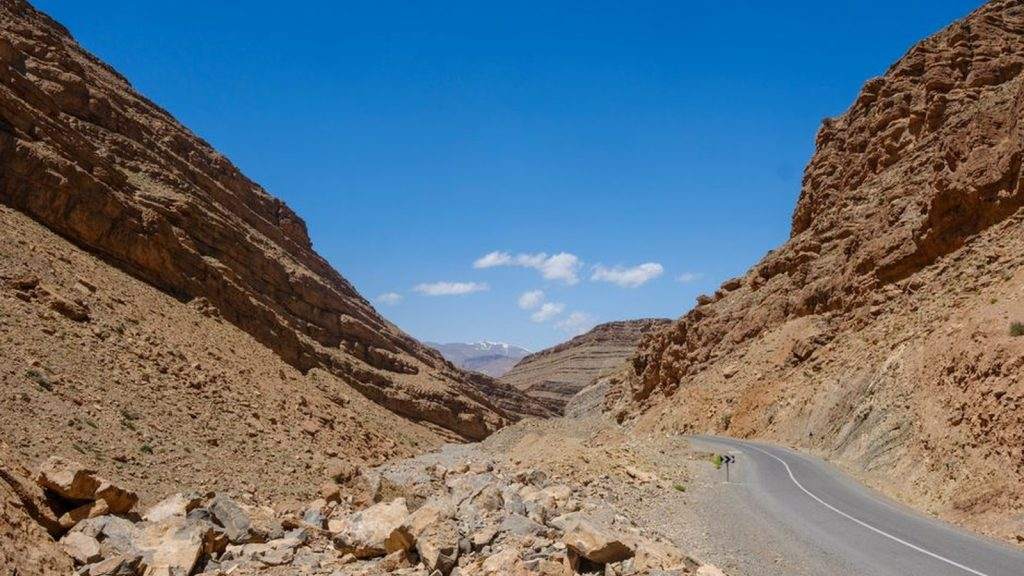
| Inside the Dadès and Todra gorgesSheer rock on both sides | At the mouth only | Assume nothing once you are between the walls. It is a short stretch. |
| Erfoud & Rissani | Good | Last town-grade signal before the dunes. Do anything that matters here. |
| Merzouga village | Good | A real town with real coverage, right at the edge of the erg. |
| Camps near the edge of Erg Chebbi | Often workable | Messaging and a photo usually get through. Do not promise anyone a video call. |
| Deep Erg Chebbi / Erg ChigagaAn hour or more across open sand | None | Plan to be completely offline. This is the good bit. |
The pattern is simple enough to memorise: towns have signal, scenery does not. Coverage in Morocco follows where people live, and your itinerary is deliberately going where they don’t.
The twenty minutes that make the trip painless
Do this on the hotel WiFi in Marrakech the night before. Not in the car, and not at the last petrol station.
- Download the offline map. In Google Maps, search the region, then choose to download the offline area — get a box that covers Marrakech to Merzouga in one go. Navigation, search and directions all keep working with no signal at all. This single step removes the most common panic.
- Screenshot everything you will need to show someone. Camp booking confirmation, driver’s name and number, hotel address in Arabic or French, return flight details. A screenshot works with a dead connection; an email in an app often does not.
- Save your driver’s and camp’s phone numbers to your contacts — properly, not left in a WhatsApp thread you would have to load.
- Download your entertainment. Podcasts, a playlist, something for the children. There is a lot of road on this trip and the scenery does eventually stop being novel for an eight-year-old.
- Tell someone at home the plan, including the words “you will not hear from me for about a day and that is normal”. This prevents the only genuinely bad outcome of going offline, which is somebody at home panicking.
- Take cash. Not connectivity, but the same category of problem: card machines out there depend on a connection too, and there is no cash machine in the dunes.
Download the offline map. Nine out of ten “we got lost with no signal” stories are solved entirely by the step that takes ninety seconds on hotel WiFi.
What “the camp has WiFi” actually means
Plenty of desert camps advertise WiFi. It is worth understanding what is behind that word before you rely on it, because there are three quite different things being described.
A router on a mobile signal
- Most common at camps near the edge of the erg
- Works as well as the mobile signal at that spot — no better
- Usually fine for messaging, not for video
- Shared by the whole camp in the evening
WiFi in the common tent only
- One access point at the dining tent
- Nothing in your own tent
- Perfectly reasonable — just not what people picture
Satellite
- A small number of upmarket camps now advertise satellite internet
- Genuinely changes what is possible that far out
- Still rare, and worth confirming directly rather than assuming
The reliable move is to ask the camp directly, in writing, before you book: is there internet in the sleeping tents, or only in the common area? They have watched hundreds of guests test it and they will tell you the truth, because a guest who arrives with the right expectation does not complain.
The Atlas day trips from Marrakech
The mountain excursions are a shorter version of the same story, and they catch people out precisely because they are day trips — you do not prepare for a day trip the way you prepare for the desert.
| Where | Signal | Note |
|---|---|---|
| Ourika valley | Patchy | Fine in the villages, gone between them and up at the waterfalls |
| Imlil and the Toubkal trailheads | In the village | Signal in Imlil itself; assume none once you start climbing |
| Ouzoud waterfalls | Usually fine | A well-visited site with cafés and coverage |
| Agafay “desert” | Generally good | Close to Marrakech — it is stony hills, not the Sahara |
| Tizi n’Tichka & high passes | Unreliable | Do not plan a call around the drive |
If you are trekking rather than driving — Toubkal, the Mgoun, anything with an overnight refuge — treat it exactly like the deep desert: offline maps, screenshots, someone at home who knows the plan, and no expectation of contact until you are back down.
What a pocket WiFi changes here, and what it does not
Worth being straight about this, because it is the question people actually have.
A pocket WiFi runs on the same mobile network your phone would use. Nobody can sell you coverage in a place with no mast. On the Tizi n’Tichka pass and deep in the erg, a router has exactly the same nothing your phone has.
What it does change is everything either side of those gaps. On the long covered stretches — which is most of the drive — one connection serves the whole car rather than one person’s phone: the children’s tablets, a laptop, everyone’s maps at once, without anybody hotspotting and flattening the phone that has the directions on it. And it holds a signal in the towns better than a phone tucked in a pocket, because it can sit on the dashboard with a clear view out.
It is collected and returned in Marrakech, including at Menara airport, and then it simply comes with you for the rest of the country. If you are travelling as a group, the arithmetic for that is in our guide to internet for families and groups.
Frequently asked questions
Is there internet in the Sahara desert in Morocco?
In the towns at the edge of it — Merzouga, Rissani, Erfoud, M’Hamid — yes, ordinary 4G. Once you are properly into the dunes, no. Camps a short ride from the edge of Erg Chebbi often have a usable signal; camps deep in Erg Chigaga generally have nothing at all.
Do desert camps in Morocco have WiFi?
Many advertise it, and it usually means a router running on the local mobile signal, often only in the common tent. A few upmarket camps now advertise satellite internet. Ask the camp directly whether there is internet in the sleeping tents or only in the communal area.
Which network works best in the Moroccan desert?
Maroc Telecom. It was the state operator, it inherited the rural infrastructure, and it consistently has a mast where the others do not. That advantage matters little in Marrakech and a great deal on the road south.
Will Google Maps work without signal in Morocco?
Yes, if you download the offline area first. Navigation, search and turn-by-turn directions all keep working with no connection. Do it on hotel WiFi before you leave the city — it is the single most useful preparation for this trip.
Will a pocket WiFi work in the Sahara?
In the desert towns and at many camps near the edge of the erg, yes. Deep in the dunes, no — it uses the same mobile network as a phone, and no device can reach a mast that is not there. Its value on a desert trip is covering the long driven stretches for everyone in the car at once.
How long will I be without a connection on a desert trip?
On the standard three-day Merzouga trip, realistically a few hours at a time on the passes and gorges, and one night at the camp. It is rarely more than that, and if you have told someone at home to expect it, it costs you nothing.
One connection for the whole car
€4.90 per day · unlimited data · up to 10 devices · free delivery and collection in Marrakech
Check dates and book
Want the signal map instead? Read where a pocket WiFi works in Morocco.
Signal descriptions reflect consistent traveller reports on these routes rather than an operator coverage map, and conditions change. Prices correct on 8 September 2026 — see the pricing page for the current rate.